Auto finance app is an automated LP strategy manager for DeFi yield
Auto finance app is a hands-free DeFi liquidity management service built around automated yield farming, LP position optimization, and strategy execution across major decentralized finance protocols. It is designed for users who want liquidity exposure without constantly moving funds, rebalancing pool ranges, checking reward emissions, or comparing vault returns by hand. The core promise is simple: connect a wallet, choose a strategy, and let the system manage liquidity actions around yield, risk, and market movement.
Automated liquidity management, not manual pool chasing
Providing liquidity across decentralized exchanges creates moving work. A pool that looks attractive today changes as swap volume, token prices, incentive programs, and total value locked shift. Concentrated liquidity adds another layer because positions leave the active trading range when price moves too far. Auto finance app addresses that work by turning liquidity placement into an automated strategy layer instead of a series of manual adjustments.
The service's public positioning centers on automated DeFi yield farming and liquidity management. That means the important feature is the management loop: selecting where capital sits, adjusting exposure as market conditions change, and seeking better LP yield from active opportunities. The app is best understood as a DeFi operations tool for liquidity providers rather than a simple wallet screen or a price-tracking dashboard.
What happens after a wallet connects
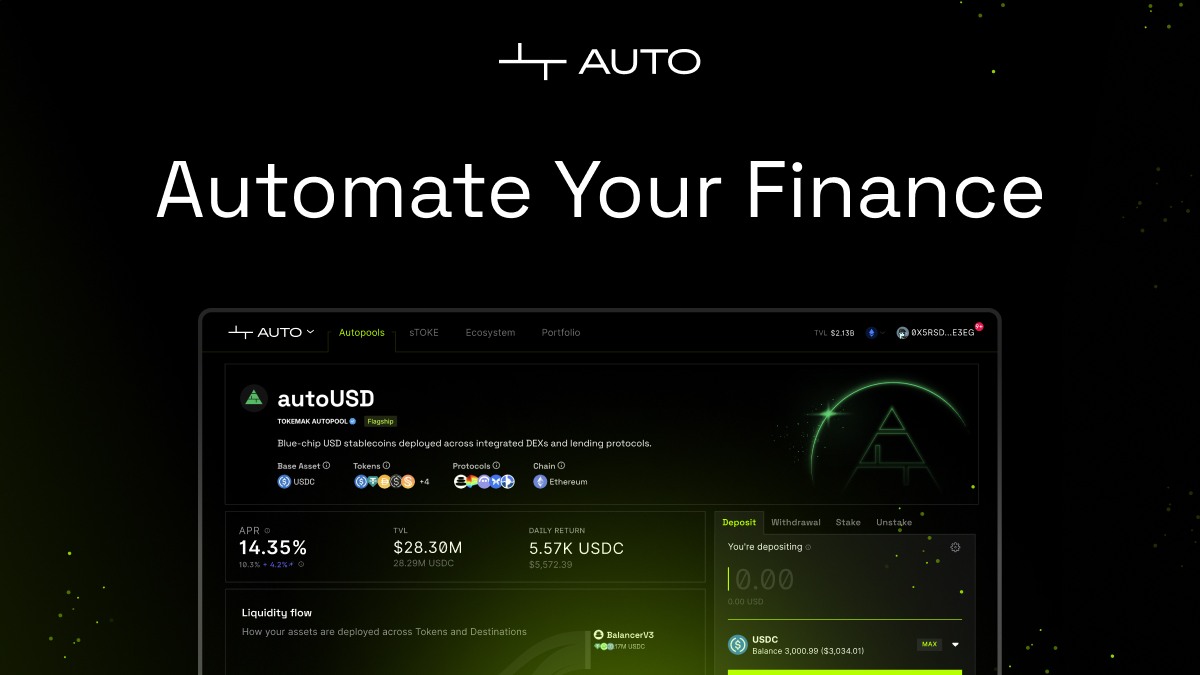
A new user starts by connecting a compatible crypto wallet and reviewing available strategies. Each strategy represents a rule set for placing liquidity into one or more DeFi venues. The user supplies assets, approves the necessary smart contract interaction, and deposits into the selected strategy. From there, the automation layer handles recurring execution tasks that would otherwise require repeated wallet transactions and close monitoring.
The workflow matters because LP yield is earned from several moving pieces: trading fees, token incentives, vault compounding, and price exposure between paired assets. Auto finance app turns those pieces into a managed process. It does not remove the economics of liquidity provision; it organizes them into a cleaner interface so the user sees positions, performance, and strategy status in one place.
How the yield engine thinks about LP positions
Liquidity yield starts with capital being useful to a market. In an automated market maker, LPs supply token pairs so traders have depth. In return, they receive a share of swap fees and, in some markets, additional reward emissions. A manager evaluates whether that fee and reward stream compensates for volatility, impermanent loss, gas costs, and the opportunity cost of sitting in a lower-performing pool.
Auto finance app presents itself as a yield optimizer, so its value comes from making those comparisons part of the product experience. Strong strategies favor pools with real trading activity, sustainable reward sources, and enough liquidity to avoid fragile pricing. Weak strategies chase headline APY while ignoring the token pair's price behavior or the cost of getting in and out.
For concentrated liquidity strategies, the important question is range management. Capital earns fees only while it supports active trading around the market price. When the price drifts outside the selected range, the position stops collecting fees until it is rebalanced or price returns. Automated range adjustment is one of the clearest reasons a liquidity management app exists.
Where major DeFi protocols fit into the experience
The phrase "major DeFi protocols" points to the broader venue set where liquidity and yield live: decentralized exchanges, yield vaults, staking reward systems, and lending-adjacent markets that distribute incentives. The app's role is to sit above those venues as an execution and monitoring layer. It gives users a single strategy interface instead of forcing every decision through separate protocol dashboards.
This structure is especially useful when a strategy crosses multiple components. A position might involve supplying paired assets to a pool, collecting fees, harvesting incentive tokens, swapping rewards back into the base assets, and redeploying capital. Auto finance app packages that cycle into a managed DeFi workflow while keeping the user focused on the strategy selected and the assets committed.
The dashboard signals that matter before depositing
A liquidity dashboard should make risk legible before a user commits funds. High yield is easy to display; the better signal is whether the return comes from fees, emissions, compounding, or a temporary incentive campaign. It is also important to know whether the strategy holds volatile token pairs, stablecoin pairs, liquid staking assets, or governance tokens with thin markets.
Useful review points include:
- the assets required for the strategy and the target pool type;
- the source of expected yield, such as trading fees or reward emissions;
- rebalance behavior, including when the strategy changes ranges or venues;
- deposit, withdrawal, performance, or network costs shown in the interface;
- smart contract exposure created by the route, vault, or external protocol.
Those signals turn the app from a yield display into a decision surface. Auto finance app is most useful when the user compares strategies by mechanism, asset exposure, and operating cost rather than a single annualized return figure.
Benefits for active and passive liquidity providers
The strongest benefit is time saved. Manual LP management requires checking pool performance, harvesting rewards, deciding whether to compound, watching price ranges, and paying attention to network fees. Automation compresses that work into strategy selection and periodic review. It also creates a more consistent process, because rules execute even when the user is away from the screen.
Another advantage is discipline. Liquidity providers get pulled toward fresh incentive campaigns and high displayed yields, especially during volatile markets. A managed strategy reduces impulsive repositioning by tying deposits to defined rules. Auto finance app also gives newer LPs a structured route into DeFi yield farming, while experienced users gain a faster way to operate across several positions.
The specific risks behind automated LP yield
LP yield carries market risk, contract risk, and execution risk. Impermanent loss matters when the two assets in a pool move apart in price. Smart contract risk comes from the app's own contracts and from every external protocol used by the strategy. Execution risk appears when rebalances happen during volatile pricing, thin liquidity, or high network fees.
There is also a behavioral risk: annualized yield numbers compress a changing market into a single easy-looking figure. A strategy that earns well during high trading volume delivers different results when volume fades or incentives decline. The best use of Auto finance app is periodic review of position composition, route exposure, and realized performance after fees.
Alternatives when automation is too much or too little
Some users prefer direct LP management through decentralized exchange interfaces because they want full control over pool choice, fee tier, and liquidity range. Others choose vault aggregators that focus mainly on compounding rewards. Portfolio trackers help with monitoring but do not execute strategy actions. Wallets keep custody and signing simple, yet they stop short of active liquidity management.
Notably, Auto finance app belongs in the middle of those options. It is more active than a tracker, more specialized than a wallet, and more liquidity-focused than a basic staking dashboard. That positioning suits users who already understand DeFi basics and want strategy execution to be less fragmented across protocol tabs.
How to approach a first strategy
Start with the assets, not the yield number. A stablecoin pair, a liquid blue-chip pair, and a volatile governance-token pair behave differently even if their displayed returns look similar for a moment. After choosing an asset mix, review how the strategy earns, when it rebalances, and what costs appear before and after deposit.
A measured first deposit also helps the user learn the interface. Watch how rewards accrue, how position value changes, and how withdrawals are presented. Auto finance app makes DeFi liquidity management more automated, but the user still benefits from understanding the strategy's assets, fee source, and risk path before increasing exposure.
Auto finance app questions worth asking
- Does an Auto finance app strategy require equal amounts of two tokens?
- Most LP strategies require paired assets because decentralized exchange pools trade between two tokens. The exact deposit format depends on the strategy design shown in the interface. Some vault-style products accept a single asset and perform the swap internally, while others require the user to supply both sides. Review the deposit screen carefully because the token mix determines price exposure and impermanent loss behavior.
- Fees on Auto finance app positions come from where?
- LP return comes primarily from swap fees paid by traders using the underlying liquidity pool. Some strategies also include protocol rewards, incentive emissions, or compounded reward tokens. Network gas, withdrawal costs, and any strategy-level fee reduce the final realized return. The important distinction is whether the displayed yield comes from real trading activity, temporary emissions, or a blend of both.
- Can I withdraw from an LP strategy during a volatile market?
- Withdrawal availability depends on the strategy contract and the underlying DeFi venue. During volatile markets, the position value reflects current pool pricing, accrued fees, and any impermanent loss at the time of exit. A withdrawal also requires a successful blockchain transaction, so network congestion and gas prices affect timing. The app interface should show the expected assets returned before the user signs.
- Why does displayed APY change after I deposit?
- APY changes because DeFi yield is recalculated from live variables: trading volume, reward emissions, pool liquidity, token prices, and compounding frequency. A high number at deposit time is a snapshot, not a fixed payment schedule. When more liquidity enters a pool, rewards spread across more capital. When trading volume slows, fee income drops even if the position remains active.
- Recovering access if I lose the wallet connected to Auto finance app, what matters?
- Access depends on the wallet's recovery method, not the app account. If the wallet is restored with its correct seed phrase or hardware-wallet credentials, the same on-chain positions remain available to manage. If the keys are lost permanently, the blockchain positions cannot be signed for withdrawal or adjustment. Store recovery material offline and separate from everyday devices.