Auto finance is automated liquidity management for DeFi LP yield
Auto finance is a hands-free DeFi liquidity management service for users who want LP exposure without constantly moving ranges, claiming rewards, and comparing yield opportunities across protocols. It focuses on automated yield farming and liquidity position optimization, so the core job is straightforward: allocate liquidity, keep positions productive, and reduce the repetitive work that makes active LP management difficult for ordinary wallet users.
Managed LP ranges across DeFi markets
Liquidity provision sounds passive until a position needs attention. In an automated market maker, capital earns trading fees while it sits where swaps happen. When price moves away from the active range, fee income slows or stops. Auto finance addresses that operational problem by treating LP positions as managed strategies rather than one-time deposits.
The service belongs to the same broad category as vault-style liquidity managers, yield optimizers, and automated strategy layers. The distinctive angle is the pairing of hands-free LP management with a focus on major DeFi protocols. That matters because liquidity depth, trading volume, reward emissions, and smart contract design differ sharply from market to market. A good strategy is less about chasing a headline APY and more about keeping capital in the part of the pool where fees and incentives actually accrue.
How automated compounding changes the LP routine
Active LP work has several small tasks that become expensive in time and gas: selecting pools, choosing ranges, harvesting incentives, reinvesting rewards, and deciding when to rebalance. Auto finance packages those chores into automated strategies. The user supplies supported assets through a connected wallet, chooses an available strategy, and lets the automation handle position maintenance according to the strategy rules.
Behind that simple workflow is a loop familiar to DeFi yield systems. Deposited assets are placed into liquidity pools, the position earns swap fees and any eligible protocol rewards, and the strategy periodically adjusts or compounds. Rebalancing matters most in concentrated liquidity designs, where a narrow range earns more when price stays inside it and earns less when price moves outside it. Automation turns that monitoring burden into a rules-based process.
Where strategy automation earns its keep
The strongest use case is a wallet holder who already understands LP risk and wants less manual administration. It also fits users who hold paired assets, such as a volatile token and a stablecoin, and prefer systematic exposure instead of ad hoc yield hunting. Auto finance is built for that middle ground between doing everything by hand and leaving assets idle.
This type of tool also helps with consistency. Manual LPs frequently delay routine maintenance because the position looks fine at a glance, gas is inconvenient, or the market changes while they are away. A strategy engine follows preset behavior even when the user is offline. That discipline is valuable during sideways markets, where fee collection and compounding decide much of the outcome.
- LPs who want recurring compounding without daily wallet actions
- Users comparing DeFi yield across established liquidity venues
- Asset holders who prefer structured pool exposure over spot holding alone
- Teams or treasuries that need repeatable liquidity deployment rules
- DeFi learners moving beyond simple token swaps into managed positions
Position setup before connecting capital
A sensible first session starts with the assets, not the advertised return. The user checks which tokens the strategy accepts, whether deposits require a balanced pair, how withdrawals are handled, and what wallet network is required. Auto finance operates in the world of self-custodied DeFi interactions, so the wallet signs approvals and deposits directly into smart contracts or strategy contracts.
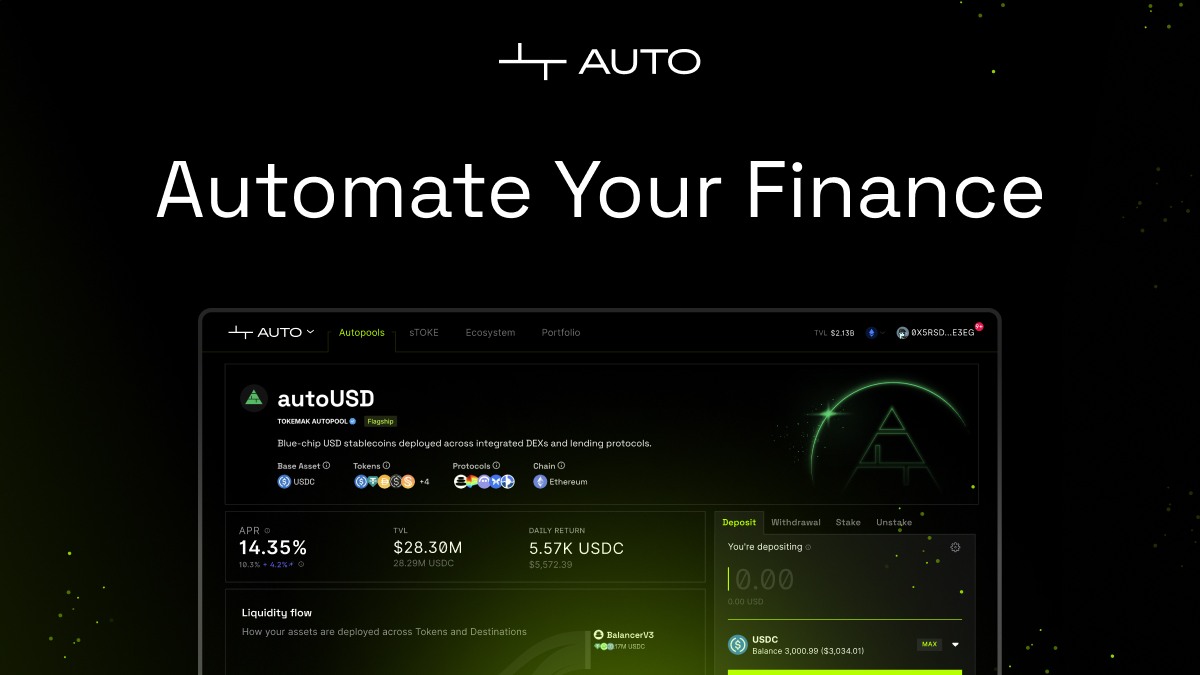
After choosing a strategy, the next decision is sizing. LP exposure carries price risk because the pool continuously rebalances the user between the two assets as traders swap. Starting with an amount that matches the user's risk tolerance keeps the learning curve controlled. Once deposited, the dashboard view should be read as a position monitor: assets supplied, share of the strategy, accumulated fees, rewards, and withdrawal value all matter.
Fees, rewards, and active range economics
Returns come from the mechanics of liquidity provision rather than a single source. Trading fees accrue when swaps pass through the pool. Protocol incentives add extra yield when a venue rewards LPs with tokens. Compounding adds those proceeds back into the position when the strategy supports it. Auto finance is therefore tied to real market activity: volume, spreads, range placement, and reward schedules all feed into the final position value.
Costs matter because automation is still on-chain activity. Gas fees, vault or strategy fees, swap costs during rebalancing, and withdrawal mechanics affect the realized return. A strategy that rebalances constantly during volatile periods spends more on execution than a quieter one. The better question is whether the fee collection, reward capture, and time saved justify those costs for the specific pool.
Impermanent loss belongs in the decision
Every LP strategy must deal with impermanent loss, the change in value that appears when pooled assets move relative to each other. Automation manages positioning; it does not erase the economics of being an LP. If one asset rallies sharply against the other, the pool holds more of the weaker asset and less of the stronger one. Fees offset that effect only when volume and strategy execution are strong enough.
That risk is clearest in volatile pairs and narrow concentrated-liquidity ranges. Stablecoin pairs reduce price divergence, while volatile pairs increase both earning potential and drawdown risk. Auto finance is most useful when the user treats LP positions as market exposure with yield, rather than as a separate category detached from token prices.
Manual LP management, vaults, and aggregators
The main alternative is manual liquidity provision on a DEX. Manual control gives the user direct choice over pool, range, timing, and reward claiming. It also requires ongoing monitoring and clear records of fees, rebalances, and token exposure. Users who enjoy tuning ranges and reacting to market structure prefer that route.
Yield aggregators and vault protocols sit closer to Auto finance. They also pool deposits and automate strategy execution, though each product differs in supported chains, contract design, fee model, and strategy transparency. A conservative comparison looks at contract maturity, withdrawal process, asset support, and whether the strategy explains how it responds to market movement. The best choice is the one whose mechanics the user understands before depositing.
Reading performance after the deposit
Performance should be evaluated over full market cycles, not only during a reward campaign. A useful review looks at deposit value, withdrawal value, earned fees, reward tokens, gas spent, and the value of simply holding the same assets outside the pool. Auto finance gives the automation layer, but the benchmark remains the user's starting assets.
Short-term APY displays change quickly because trading volume, token prices, and incentives move. A position that looks modest for a few days earns well when volume returns; a high number from a temporary reward period fades when emissions end. The practical habit is to track realized position value at intervals and understand which part came from fees, which part came from incentives, and which part came from token price movement.
What a good first strategy looks like
A first strategy should be understandable in one reading. It should name the asset pair, explain the yield source, show how compounding works, and make the withdrawal path clear. Auto finance serves users best when they select strategies that match assets they already intend to hold, because the LP position then becomes an organized way to use existing exposure.
Once the position is active, patience matters more than constant switching. Moving between pools too frequently creates extra approvals, swaps, gas costs, and fragmented records. Automated liquidity management works best as a defined allocation with a review rhythm: check the position, read the strategy behavior, compare it with the original plan, and adjust only when the market or the user's asset view has changed.
What to know about Auto finance
- Fees on Auto finance: what should users expect to pay?
- Users should expect ordinary on-chain costs plus any strategy-level fees shown in the app. The main costs are network gas, swap costs created during rebalancing, and vault or performance fees if a strategy charges them. The important figure is realized return after costs, because frequent rebalancing and reward claiming create expenses even when the gross APY looks attractive.
- Which wallets make sense for connecting to Auto finance?
- A self-custody wallet that supports the network used by the selected strategy is the right fit. The wallet must handle token approvals, contract interactions, and transaction signing. Browser wallets and mobile wallets work when they support the chain, the asset standards, and the dApp connection method required by the interface.
- Is automated LP management better than holding tokens in a wallet?
- Automated LP management suits users who want fee income and protocol rewards from assets they are willing to place into pools. Holding tokens in a wallet keeps exposure simpler and avoids LP-specific risks such as impermanent loss. The better choice depends on whether the expected fees and rewards compensate for pool risk, strategy fees, and changing token balances.
- Can a user withdraw from an automated DeFi yield strategy at any time?
- Withdrawal rules depend on the specific strategy contract and the network state. Many DeFi liquidity strategies support user-initiated withdrawals, but the received assets, gas cost, and timing depend on how the strategy unwinds the LP position. Users should read the withdrawal preview carefully because they may receive two assets rather than the exact starting balance.