Auto finance is an automated DeFi liquidity manager for hands-free LP yield farming
Auto finance is an automated DeFi liquidity management service built around LP positions, yield farming, and strategy execution across major decentralized finance protocols. It focuses on the part of DeFi that becomes tedious fast: keeping liquidity positions useful after markets move, incentives change, and ranges drift away from active trading. The service frames itself around automated yield optimization, so the user starts with a strategy goal and monitors performance rather than adjusting every pool by hand.
What the service manages inside an LP position
Liquidity provider positions earn from trading activity, incentives, or both, but they also require constant attention. A pool that looked efficient when opened becomes less effective when price moves, token weights change, or reward rates fall. Auto finance addresses that maintenance layer. The core idea is to keep DeFi capital working inside liquidity strategies without asking the user to watch every block, refresh dashboards, and rebalance manually after each market move.
The important distinction is the object being managed. This is not a simple token staking page where one asset is deposited and left alone. LP management involves paired assets, pool composition, price exposure, accrued fees, reward harvesting, reinvestment choices, and the timing of position changes. The automation matters because active liquidity strategies lose efficiency when a position drifts away from where trading volume occurs.
How automated yield farming works for liquidity providers
Automated yield farming starts by routing capital into a strategy that has rules for pool selection, rebalancing, reward handling, and compounding. When a strategy earns fees or token rewards, the system tracks those returns and applies the strategy logic that keeps the position aligned with its purpose. In a concentrated liquidity setting, that logic also means paying attention to the active price range, because idle liquidity earns less than capital placed where swaps actually happen.
More broadly, Auto finance describes its role as optimizing yield across major DeFi protocols. In plain terms, that means the service watches the moving parts that shape LP performance: trading volume, fee accrual, incentives, token ratios, and market movement. A user still needs to understand the assets being supplied, but the recurring operational work shifts into an automated strategy layer.
Where hands-free strategies add the most value
The strongest fit is capital that belongs in DeFi but should not require constant tactical maintenance. Stablecoin pools, blue-chip token pairs, and incentive-heavy pools all create different workloads. Stable pairs emphasize fee capture and capital efficiency. Volatile pairs introduce larger price movement and impermanent loss exposure. Incentive pools add another variable because reward emissions change the real return profile over time.
With Auto finance, the practical appeal is consistency. A strategy that compounds rewards, adjusts ranges, or rotates away from a fading opportunity reduces the gap between a position that was once attractive and one that stays productive. This matters most when network conditions, pool liquidity, and reward schedules move faster than an individual wants to manage from a wallet interface.
The workflow from wallet to managed liquidity
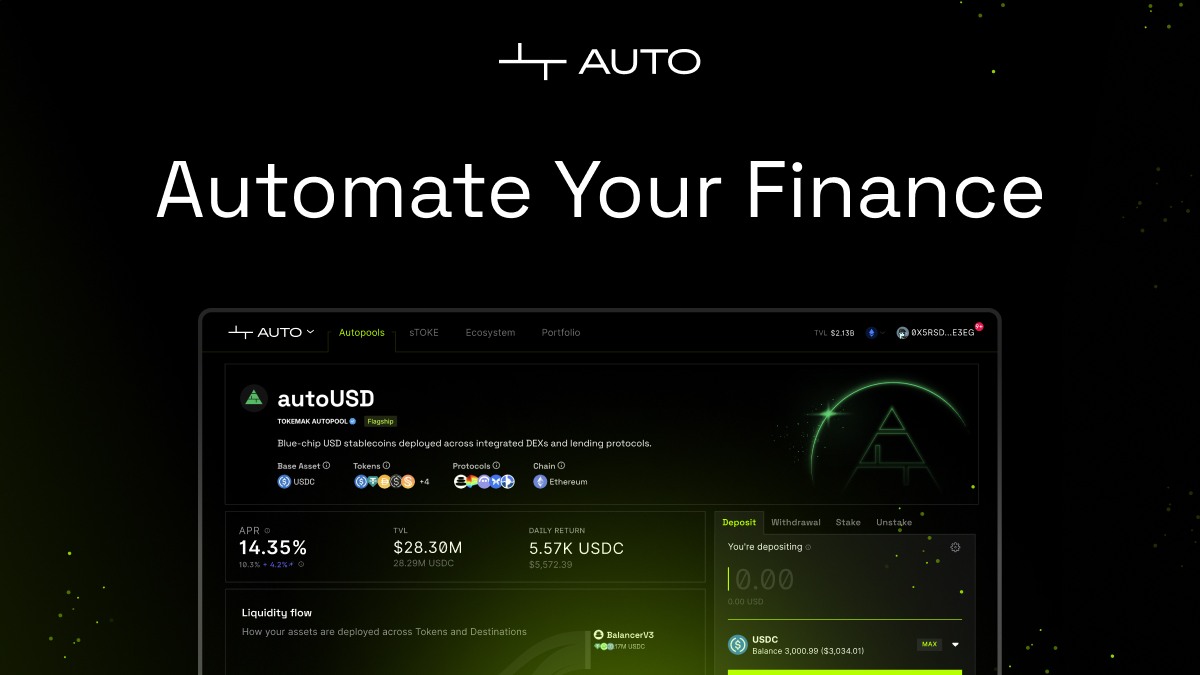
A typical DeFi workflow begins with a supported wallet, the assets required for the target pool, and enough native gas token for transactions. After connecting, the user chooses a strategy, reviews the assets involved, approves token spending where needed, and deposits into the relevant position. The dashboard then becomes the place to review deposits, current value, earned yield, and strategy activity.
Several checks belong before the first deposit:
- Confirm the wallet is on the intended network before approving tokens.
- Read which assets enter the LP position and how the pair behaves.
- Look at whether returns come from swap fees, emissions, or compounding.
- Understand when withdrawals settle and what transaction costs apply.
- Track token approvals so unused allowances do not remain open indefinitely.
These steps keep the workflow concrete. Auto finance reduces position maintenance, but the first deposit still deserves the same attention as any smart contract interaction involving pooled assets.
Fees, rewards, and the real return profile
LP returns come from several places, and each one behaves differently. Trading fees accrue when users swap through the pool. Incentive rewards come from protocol emissions or campaign budgets. Compounding increases position size when earned assets are converted or reinvested. Gas costs subtract from returns whenever a transaction executes on-chain. A good dashboard separates those components so performance is readable instead of reduced to a single attractive percentage.
Day to day, Auto finance should be evaluated through that full return profile. A high displayed yield means less when the pool has thin volume, expensive rebalances, unstable incentives, or heavy token volatility. A steadier pool with lower emissions produces a cleaner return when fees are consistent and the paired assets hold a tighter relationship. The useful question is not just what a strategy earned yesterday; it is whether the strategy's mechanics match the assets and time horizon.
Impermanent loss belongs in every LP decision
Impermanent loss is the change in value that appears when pooled assets move against each other compared with simply holding them. It is part of AMM liquidity provision, especially in volatile pairs. Automation does not erase that exposure. It manages the position around it by adjusting placement, compounding earnings, and keeping the strategy responsive to market conditions.
This is the one caution that matters most: a managed LP strategy still carries smart contract risk, market risk, and pair-selection risk. Auto finance is best understood as an execution and optimization layer, not as protection from bad assets or extreme price movement. The more volatile the pair, the more important it becomes to compare earned fees and incentives against the value lost from divergence.
How it differs from vaults, aggregators, and manual farming
Manual farming gives maximum control, but it demands regular decisions: when to harvest, when to rebalance, when to exit, and how to compare pools. Yield aggregators such as Yearn Finance and Beefy Finance popularized automated compounding vaults, especially for single-asset and LP-token strategies. Managed liquidity systems go deeper into the LP mechanics, particularly when the strategy needs active range management rather than passive reinvestment.
Importantly, Auto finance belongs in that managed-liquidity category. The page language emphasizes automated DeFi yield farming and liquidity management, which points to active handling of LP positions rather than a static deposit wrapper. Compared with a user clicking through each protocol directly, the value is a more unified strategy surface for monitoring and maintaining positions across decentralized markets.
Who benefits from this kind of DeFi automation
It suits users who already understand wallet custody, token approvals, AMM pools, and basic DeFi risk, yet do not want LP management to become a daily routine. It also fits teams or individuals that treat liquidity as a portfolio allocation instead of a short-term campaign chase. The service is less appropriate for someone who has not chosen assets carefully, because automation improves execution after the underlying pool decision has been made.
In practice, Auto finance is most useful when the user has a clear intent: earn from liquidity provision, reduce the manual burden of rebalancing, and keep a closer eye on strategy performance from a single interface. That makes it part of the wider shift from raw DeFi dashboards toward managed execution tools, where smart contracts and strategy logic handle repetitive work while the user remains responsible for capital allocation.
Auto finance questions worth asking
- Does Auto finance custody my tokens after I deposit?
- The service is built around DeFi smart contract interaction rather than a traditional account balance. Your wallet signs approvals and deposit transactions, then the strategy contract manages the position according to its rules. The practical point is to treat every approval and deposit as an on-chain action: review the contract prompt, understand what is being approved, and keep track of active allowances.
- How long does it take for a managed LP position to start earning?
- Earnings begin only after the deposit transaction confirms and the assets enter the strategy. Fee accrual then depends on swap activity in the underlying pool, while incentive rewards follow the relevant protocol's reward mechanics. A position can show value changes immediately because token prices move, but meaningful performance data needs enough trading activity and time to separate fees from market noise.
- Can I withdraw from an automated liquidity strategy whenever I want?
- Withdrawal behavior depends on the strategy contract, the underlying protocol, network congestion, and any position mechanics involved. Many DeFi LP strategies allow user-initiated withdrawals through the connected wallet, but the final amount reflects current pool prices, accrued fees, pending rewards, and transaction costs. Review the withdrawal screen before signing so the received assets and gas cost are clear.
- Which risks are easiest to miss in hands-free DeFi yield farming?
- The easy-to-miss risks are token divergence, changing reward emissions, gas costs during rebalancing, and smart contract exposure across every protocol the strategy touches. A displayed yield figure does not show all of those in one number. Look at the pair, the source of rewards, the strategy behavior, and the cost of entering or exiting before sizing a position.
- Is a managed LP strategy better than holding the two tokens separately?
- It is better only when earned fees and rewards compensate for the risks and price behavior of the pair. Holding the tokens separately avoids AMM impermanent loss but misses pool fees and farming incentives. A managed strategy adds automation around the LP position, so the comparison should include fee income, reward value, token divergence, gas costs, and the user's willingness to monitor the assets.